
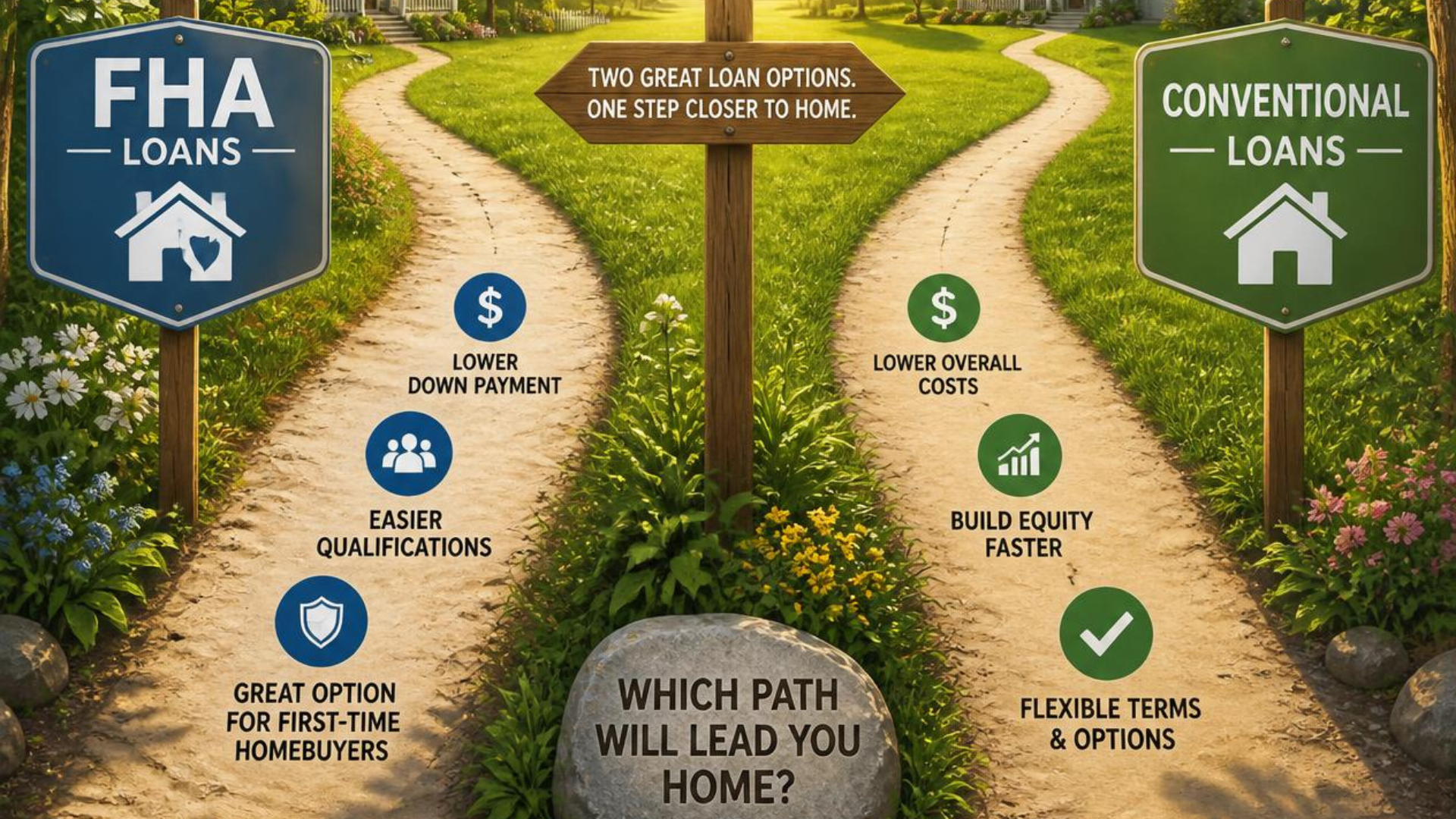
The Conventional vs. FHA Loan Showdown: Choosing Your Best Mortgage Path
When shopping for a home, choosing the right financing structure is just as critical as finding the right property. For civilian borrowers, the two most common mortgage paths are Conforming Conventional loans and government-insured FHA loans.While both options allow you to purchase a home with a minimal down payment, they are built on entirely different underwriting guidelines, credit standards, and mortgage insurance structures. Here is a practical, easy-to-understand breakdown to help you determine which path fits your financial profile.
1. The Core Differences Defined
-
Conforming Conventional Loans: These are private mortgages that adhere to the underwriting and purchase guidelines established by Fannie Mae and Freddie Mac. Because these loans are not directly backed or insured by the federal government, private lenders take on more risk and enforce stricter credit standards. For 2026, the Federal Housing Finance Agency (FHFA) has set the baseline conforming loan limit for a single-family home at $832,750 in most areas.
-
FHA Loans: These mortgages are issued by private lenders but directly insured by the Federal Housing Administration (FHA), a division of the Department of Housing and Urban Development (HUD). This government safety net protects lenders from default losses, which allows banks to offer highly flexible qualification requirements. For 2026, the baseline FHA loan limit for a single-family home is $541,287 in low-cost areas.
2. Credit Score and Down Payment Flexibilities
Historically, conforming conventional loans required a rigid minimum credit score of 620. However, on November 16, 2025, Fannie Mae and Freddie Mac eliminated the hard credit score cutoff in favor of a holistic credit risk rating system.
Under this system, automated underwriting engines analyze a borrower's complete credit profile, including payment history, credit utilization, and credit age, to determine eligibility. Conforming conventional programs (such as HomeReady and Home Possible) allow eligible first-time buyers to put down as little as 3%, while repeat buyers typically require a 5% minimum down payment.
FHA loans, by contrast, offer a much more forgiving path for buyers with lower credit scores. A borrower with a credit score of 580 or higher can qualify for maximum financing with a down payment of just 3.5%. Borrowers with credit scores between 500 and 579 can still secure FHA approval, provided they make a 10% down payment.
3. Underwriting Parameters: Side-by-Side Comparison
-
Credit Score Minimum: FHA requires 580 (for 3.5% down) or 500-579 (for 10% down). Conventional utilizes a holistic credit risk rating system (historically a 620 minimum).
-
Minimum Down Payment: FHA requires 3.5% or 10% (credit score dependent). Conventional allows 3% for first-time buyers and 5% for repeat buyers.
-
Standard Debt-to-Income (DTI) Cap: FHA is standardly capped at 43%, but can stretch to 50% or more with compensating factors like cash reserves. Conventional is typically capped at 45%, but can extend to 50% under automated underwriting.
-
2026 Baseline Loan Limits: FHA is capped at $541,287 in low-cost areas. Conventional is capped at $832,750.
-
Property Condition Standards: FHA enforces strict Minimum Property Standards focused on safety, security, and structural soundness. Conventional focuses primarily on market value and is highly flexible on minor cosmetic issues.
-
Eligible Property Types: FHA can be used for primary residences only. Conventional can be used to finance primary homes, vacation/second homes, and investment properties.
4. The Mortgage Insurance Battle: PMI vs. MIP
The single biggest long-term cost difference between these two programs is how they handle mortgage insurance.
-
Conventional Private Mortgage Insurance (PMI): PMI is only required on conventional loans if your down payment is less than 20%. PMI is risk-based, meaning your rate is determined by your credit score and down payment.
Most importantly, under the Federal Homeowners Protection Act of 1998, conventional PMI is not permanent. It automatically terminates once your loan-to-value (LTV) ratio drops to 78% of the original purchase price through scheduled principal payments, and you can request its cancellation at 80% LTV.
-
FHA Mortgage Insurance Premium (MIP): FHA loans require you to pay mortgage insurance regardless of your down payment size, even if you put down 20% or more. FHA charges two separate premiums: a 1.75% upfront MIP (which is typically financed directly into the loan amount) and an annual MIP of 0.55% (divided into 12 monthly payments) on typical 30-year loans.
If your down payment is less than 10%, FHA MIP lasts for the entire life of the loan and can only be removed by refinancing into a non-FHA mortgage. If your down payment is 10% or more, FHA MIP automatically cancels after 11 years of on-time payments.
5. A Real-World Numerical Example
To illustrate the long-term economic difference, let’s compare both loans on a $350,000 home purchase price:
The FHA Loan (3.5% Down)
-
Down Payment: $12,250
-
Base Loan Amount: $337,750
-
Upfront MIP (1.75%): $5,911 (financed into the loan)
-
Total Loan Amount: $343,661
-
Interest Rate: 6.40%
-
Monthly Payment (Principal + Interest): $2,143
-
Monthly MIP (0.55%): $157
-
Total Monthly Mortgage Payment: $2,300
-
Total MIP Paid Over 30 Years: $56,520
The Conforming Conventional Loan (5% Down)
-
Down Payment: $17,500
-
Upfront Fees: $0
-
Loan Amount: $332,500
-
Interest Rate: 6.15%
-
Monthly Payment (Principal + Interest): $2,018
-
Monthly PMI (0.60%): $166
-
Total Monthly Mortgage Payment: $2,184
-
Total PMI Paid (Before automatic cancellation at 78% LTV): $11,400
The Bottom Line
While the upfront out-of-pocket down payment is $5,250 higher for the conventional loan, the conventional path saves you $116 a month in total payments and $45,120 in total mortgage insurance costs over the life of the loan.
Ultimately, conventional financing is almost always the more cost-effective choice if you have a credit score above 680 and can afford a 5% down payment. However, if your credit score is still building or your debt-to-income ratio is high, an FHA loan remains the premier, highly accessible tool to unlock homeownership.